French drain vs grading decisions depend largely on how water is moving across or through your property. Yard grading is generally used to improve the way surface water flows across the ground, while a French drain can help collect and redirect water moving through saturated soil.
For homeowners dealing with standing water, soggy areas, runoff, or water moving toward the house, understanding the difference between these two drainage solutions can make it easier to determine what type of approach may fit the problem. In some cases, grading and a French drain may even be used together.
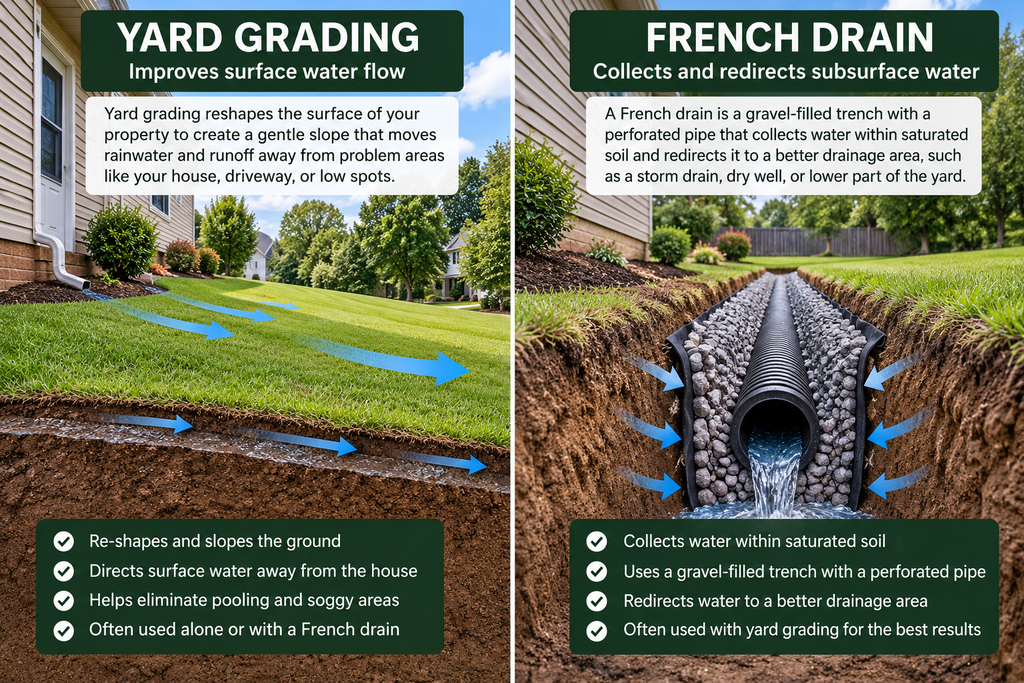
French Drain vs Grading: What’s the Difference?
The main difference is the type of water problem each approach is designed to address. Yard grading reshapes the surface of the property so rainwater and runoff flow away from problem areas. A French drain collects water within saturated soil and redirects it through a gravel-filled trench containing a perforated drainage pipe.
If water is flowing across the surface or collecting because the yard slopes the wrong way, grading may be the more appropriate solution. If the ground stays saturated or water is moving through the soil, a French drain may be more useful. The conditions on some properties can make a combination of both approaches appropriate.
When Yard Grading Is the Better Drainage Solution
Yard grading is designed to improve how water moves across the surface of a property. By reshaping low areas or correcting improper slopes, grading can encourage rainwater and runoff to move away from the house and other areas where water tends to collect.
Signs Yard Grading May Be Appropriate
- Water visibly flows toward the house during heavy rain
- Large areas of the yard hold shallow standing water
- The property contains low spots where runoff collects
- Soil near the foundation slopes toward the house instead of away from it
- Erosion or concentrated runoff develops along the same surface path after storms
Grading works best when the drainage problem is primarily related to the shape and slope of the ground. It does not necessarily solve water that is moving through saturated soil below the surface, which is where another drainage method may be needed.
When a French Drain Is the Better Drainage Solution
A French drain is designed to collect and redirect water that is moving through saturated soil. The system typically uses a perforated drainage pipe surrounded by gravel, allowing water to enter the trench and be carried toward an appropriate discharge point.
Signs a French Drain May Be Appropriate
- The ground remains soggy long after rainfall has stopped
- Water repeatedly collects along the same low area of the yard
- Soil becomes saturated even when there is little visible surface runoff
- Water appears to move through the ground from a higher area of the property
- Grading alone would not provide a practical surface path for the water
French drains are most useful when the problem involves water within the soil rather than simply runoff traveling across the surface. The location of the drain, depth of the trench, available outlet, and way water moves through the property all affect whether a French drain is appropriate.
French Drain vs. Yard Grading: Side-by-Side Comparison
| Factor | Yard Grading | French Drain |
| Primary purpose | Redirect surface runoff | Collect and redirect water within saturated soil |
| Best suited for | Improper slopes, low spots, surface runoff | Soggy soil, subsurface water, saturated areas |
| How it works | Reshapes the ground to improve surface drainage | Uses gravel and perforated pipe to collect and carry water |
| Visible after installation | Changes the slope or contour of the yard | Usually mostly hidden below ground |
| Requires an outlet | Water needs a safe direction to flow | Drainage pipe needs an appropriate discharge point |
| Can be used together? | Yes | Yes |
When You May Need Both Yard Grading and a French Drain
Some drainage problems involve both surface runoff and saturated soil. In those situations, correcting the slope of the yard may improve how rainwater moves across the surface, while a French drain can help manage water that continues to move through the soil.
For example, a property may have a low area that receives runoff from an uphill section of the yard while also remaining saturated after storms. Grading could help redirect some of the surface water, while a French drain may provide a path for water that enters and remains within the soil.
Using both approaches does not automatically make a drainage system better. The appropriate solution depends on where the water originates, how it moves through the property, and where it can be safely discharged.
How Rock Hill’s Clay Soil Can Affect the Decision
Soil conditions can influence how well a yard drains and which drainage approach may be appropriate. Rock Hill and the surrounding Piedmont region commonly have clay-rich soils that can drain slowly when saturated, allowing wet conditions to persist after heavy rainfall.
Clay soil does not automatically mean a property needs a French drain. If the primary problem is surface runoff caused by the slope of the yard, correcting the grading may still be the more appropriate approach. When water continues to saturate the soil or move through the ground, a French drain or another subsurface drainage method may be considered.
The important distinction is not simply whether clay soil is present, but how water is actually moving across and through the property. Looking at the slope, low areas, runoff paths, soil saturation, and available drainage outlets can help determine which type of solution fits the problem.
How to Decide Between a French Drain and Yard Grading
The best place to start is by watching what happens during and after a heavy rain. Where the water comes from, whether it travels across the surface or remains within the soil, and where it could safely be redirected are more important than simply choosing one drainage system over another.
Yard grading may make more sense when:
- Water visibly runs across the surface
- The yard slopes toward the house or another problem area
- Low spots collect shallow runoff
- Changing the slope can create a practical path for water to drain away
A French drain may make more sense when:
- Soil remains saturated after rainfall
- Water appears to move through the ground
- A consistently soggy area needs subsurface drainage
- Surface grading alone cannot adequately address the water problem
If the property shows signs of both surface runoff and saturated soil, the solution may involve a combination of drainage methods. A property-specific evaluation can help determine how the water is moving and which approach is appropriate.
French Drain vs. Yard Grading FAQs
Can grading fix a soggy yard?
Grading can help when a soggy area is caused by surface water collecting because of poor slope or low spots. If the soil remains saturated because water is moving through the ground, grading alone may not solve the problem.
Is a French drain better than grading?
Neither solution is automatically better. Grading and French drains address different types of drainage problems. The better approach depends on whether the problem involves surface runoff, saturated soil, or a combination of both.
Can a French drain fix water flowing toward a house?
A French drain may help in some situations, but visible surface runoff flowing toward a house can also indicate a grading problem. Redirecting surface water before it reaches the house may require correcting the slope, another drainage method, or a combination of approaches.
Do you ever need both grading and a French drain?
Yes. Some properties have both improper surface drainage and saturated soil. In those situations, grading may improve the direction of surface runoff while a French drain helps collect and redirect water within the soil.
Not Sure Whether You Need Grading or a French Drain?
If you’re dealing with standing water, soggy ground, runoff, or another drainage problem around your property, the right solution depends on how and where the water is moving.
Carolina Yard Drainage helps connect homeowners in Rock Hill, SC and surrounding areas with drainage solutions based on the conditions of the property. Submit an estimate request to start the process of finding an appropriate solution for your drainage problem.