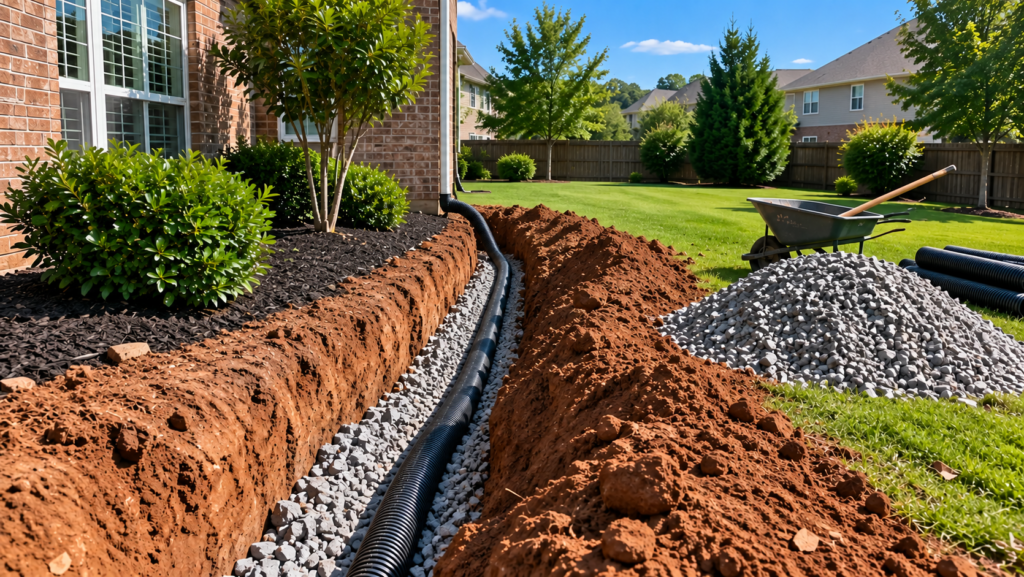
French Drain Cost in Rock Hill, SC
Learn what affects French drain installation cost, why estimates vary from property to property, and what homeowners in Rock Hill, SC should consider before choosing a drainage solution.
How Much Does a French Drain Cost in Rock Hill, SC?
French drain installation costs can vary significantly from one property to another because the price depends on more than the length of the drain. Trench depth, soil conditions, accessibility, excavation requirements, pipe and stone materials, discharge location, and restoration work can all affect the final project cost.
The total project price depends less on a simple per-foot calculation and more on what is required to solve the drainage problem correctly. A short drain with difficult access, deep excavation, or extensive restoration can cost more than a longer, straightforward installation.
French Drain Cost Rock Hill SC: What Affects the Price?
The final cost of a French drain depends on the conditions of the property and the work required to install the system correctly. Some of the biggest cost factors include:
- Total length of the drainage route
- Depth and width of excavation
- Amount of stone and drainage pipe required
- Clay, compacted soil, roots, or rocky ground
- Access for excavation and material delivery
- Where collected water can safely discharge
- Whether catch basins or additional drainage components are needed
- Existing landscaping, fencing, patios, or other obstacles
- Amount of lawn or landscaping restoration required after installation
Why French Drain Prices Vary So Much
Two French drains of the same length can have very different installation costs. One property may have open access, shallow excavation, and an easy discharge location, while another may require deeper trenching, difficult equipment access, more excavation, additional stone, or extensive restoration after the drain is installed.
That is why comparing estimates based only on total length can be misleading. The drainage route, installation depth, materials, outlet, and restoration should all be considered when comparing project costs.
French Drain Cost Per Linear Foot
There is no standard per-foot price for a French drain in Rock Hill because contractors set their own pricing based on the property and scope of work. For general budgeting purposes, published consumer cost guides commonly report broad per-linear-foot ranges for exterior French drain installation. These figures can provide a starting point for planning, but they should not be treated as a Rock Hill price, contractor quote, or estimate for a specific property.
For general planning, published consumer cost guides commonly show exterior French drain installation ranging from about $10 to $35 per linear foot, with some projects falling outside that range depending on installation conditions. This is a broad national budgeting range rather than a Rock Hill average, and actual contractor pricing may vary significantly.
Typical French Drain Project Scopes
Short, Straightforward Drainage Runs
A shorter French drain across an open lawn with easy access and a nearby gravity outlet will generally be less expensive than a system that requires deep excavation or extensive routing.
Longer Yard Drainage Systems
Longer drainage routes require more pipe, stone, excavation, labor, and restoration. Costs may also increase when the system must curve around landscaping, structures, utilities, or other obstacles.
Complex Drainage Projects
Properties with difficult access, heavy clay, deep cuts, multiple drainage runs, constructed outlets, or several water sources may require a more involved system. These projects can cost substantially more than a simple straight-line French drain.
How Clay Soil Can Affect French Drain Cost
Clay-heavy soil can affect the complexity of a French drain installation because excavation may be slower and saturated ground can make trenching and site access more difficult. Soil conditions may also influence the depth, stone requirements, drainage path, and restoration needed for the project.
However, clay soil by itself does not determine the cost of a French drain. A contractor still needs to consider how water is moving across the property, the length and depth of the proposed system, equipment access, the available discharge point, and the amount of restoration required after installation.
The Discharge Point Matters
A French drain needs a suitable location where collected water can be discharged. The distance to that outlet, changes in elevation, obstacles along the drainage route, and the work required to reach an appropriate discharge point can all affect the scope and cost of the installation.
A nearby gravity-fed outlet may keep the installation relatively straightforward, while a distant or difficult outlet can require additional trenching, pipe, excavation, and restoration. In some situations, site conditions may also limit which discharge options are practical.
French Drain Cost vs. Other Drainage Solutions
A French drain is not always the right solution for a drainage problem. Depending on where the water comes from and how it moves across the property, another drainage method may be more appropriate and may involve a different project scope and cost.
Catch Basin Drainage
A catch basin may be more appropriate when surface runoff collects at a defined low point rather than moving through saturated soil.
Underground Downspout Drainage
If roof runoff is creating the wet area, routing downspouts underground may address the source more directly than installing a French drain.
Yard Grading & Drainage Correction
When poor slope or low areas cause water to collect, grading may improve surface drainage without relying entirely on an underground system.
Some properties benefit from combining more than one drainage method. The important part is matching the solution to how water actually moves across the site.
What Should Be Included in a French Drain Estimate?
A useful French drain estimate should explain more than the total price. Homeowners should be able to understand the proposed drainage route, where the collected water will discharge, what materials and installation work are included, and what restoration will be needed after the project is complete.
- Approximate drainage route and length
- Excavation depth and system design
- Drainage pipe and aggregate
- Collection points or catch basins if needed
- Discharge or outlet location
- Removal of excavated material when required
- Lawn or landscape restoration
- Any work excluded from the estimate
Is a Cheaper French Drain Always Better?
A lower quote is not automatically a better value if the proposed system does not address the source of the drainage problem or leaves out important parts of the installation. Differences in trench depth, materials, stone, drainage fabric, outlet design, restoration, and overall scope can make two contractor estimates difficult to compare based on price alone.
The goal should be to solve the water problem with a practical system rather than simply install the lowest-cost trench.
How to Get an Accurate French Drain Estimate
An accurate French drain estimate usually requires evaluating the property rather than relying on a per-foot price alone. The drainage problem, water source, route of the proposed system, discharge location, access, soil conditions, and restoration requirements can all affect the scope of work.
1. Identify the Source of the Water
The first step is identifying where the excess water is coming from. The source may be surface runoff, roof drainage, groundwater, poor grading, or water entering from another area of the property.
2. Determine the Drainage Path
Next, the path water needs to travel should be evaluated. The proposed drainage route should account for the property’s slope, problem areas, obstacles, and how water can be moved away without creating another drainage issue.
3. Determine the Appropriate Drainage Method
Once the source and path of the water are understood, the appropriate drainage method can be determined. Depending on the property, that may involve a French drain, catch basin, underground downspout drainage, grading correction, or a combination of solutions.
4. Get a Property-Specific Estimate
Once the drainage problem and proposed solution have been evaluated, a contractor can provide an estimate based on the actual scope of work. The estimate should account for system length and depth, materials, excavation, access, discharge requirements, and restoration.
French Drain Cost FAQs
How much does a French drain cost per foot?
Published consumer cost guides commonly report broad ranges of approximately $10–$35 per linear foot for exterior or yard French drain installation. This is a general national budgeting range rather than a Rock Hill-specific price. Actual contractor quotes can vary considerably depending on excavation depth, soil conditions, access, materials, discharge location, and restoration requirements.
Why are some French drain estimates much higher than others?
French drain estimates can vary because contractors may be pricing very different scopes of work. Trench depth, drainage route, soil conditions, equipment access, materials, discharge requirements, obstacles, restoration, and additional drainage components can all affect the total project cost.
Does clay soil make a French drain more expensive?
It can. Clay-heavy or saturated soil may make excavation more difficult and can affect trench depth, materials, equipment access, and restoration requirements. However, clay soil is only one factor, so its effect on the final contractor price depends on the specific property and drainage design.
Can I get an exact French drain price without seeing the yard?
Usually not. An accurate contractor quote generally requires evaluating the property because the drainage source, proposed route, system length and depth, soil conditions, equipment access, discharge location, and restoration requirements can all affect the scope and price of the project.
Is a French drain always the best solution for a wet yard?
No. A French drain can be effective when subsurface water or saturated soil is contributing to the problem, but other drainage issues may be better addressed with a catch basin, underground downspout drainage, grading correction, or a combination of solutions. The appropriate method depends on where the water is coming from and how it moves across the property.
Want a French Drain Estimate for Your Property?
If you’re considering a French drain, the next step is having the drainage problem and property conditions evaluated so the appropriate solution and scope of work can be determined.
Carolina Yard Drainage helps connect homeowners in Rock Hill, SC and surrounding areas with drainage solutions for standing water, runoff, soggy yards, and other drainage problems.